What I Found in Varanasi’s Crowded Streets Will Blow Your Mind
You know that feeling when a place hits you right in the soul? Varanasi did that to me. I went looking for peace along the Ganges, but what I found wasn’t just spirituality—it was life, raw and unfiltered, spilling out into every ghat, alley, and morning ritual. This isn’t just a holy city; it’s a living, breathing public stage where every local walk, boat ride, and tea stall chat tells a story. Let me take you through the moments that made me see public space in a whole new light.
Arrival: First Impressions of a City That Never Sleeps
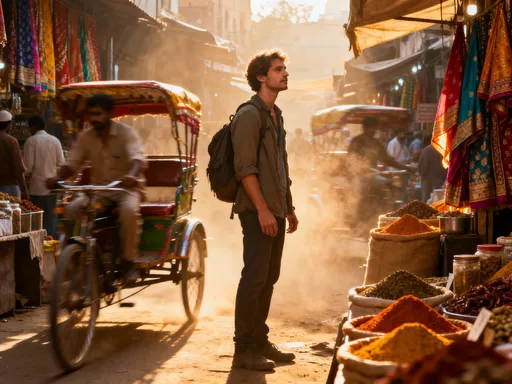
The first breath of Varanasi hits like a wave—warm, spiced with sandalwood and diesel, layered with the scent of marigolds and river mist. Stepping off the train at Varanasi Junction, the city doesn’t welcome you so much as pull you into its rhythm. Rickshaws honk in rhythmic persistence, their drivers weaving through crowds with practiced ease. Porters balance towering bundles on their heads, moving like silent sentinels through the human current. There’s no buffer between arrival and immersion. The city begins not at a terminal gate, but at the edge of your personal space.
What strikes most is not the chaos, but its coherence. Though the streets pulse with unrestrained energy, there’s an unspoken order beneath. People move in clusters, families in single-file lines, pilgrims following priests in quiet devotion. Strangers brush shoulders without apology, yet there’s no sense of intrusion—only inclusion. Public space here isn’t designed for privacy; it’s built for presence. Every inch of sidewalk, every corner of a lane, hums with shared purpose. You don’t observe life in Varanasi—you’re invited into it.
This immediacy is disorienting at first, especially for travelers accustomed to cities where public and private are strictly divided. But soon, the noise fades into background music. The press of bodies becomes comforting, like being part of a vast, moving family. Children dart between stalls with laughter trailing behind them, their games spilling into the street without fear. An elderly woman grinds spices on a stone mortar outside her doorway, nodding at passersby as if each glance is a small greeting. The city doesn’t shut its doors; it opens them wide, offering a rare kind of intimacy found only in places where life is lived collectively.
The Ghats: Where Life, Death, and Daily Rituals Coexist
Along the banks of the Ganges, the ghats rise like stone steps to the divine. These are not monuments frozen in time—they are living spaces, each with its own rhythm, function, and community. Dashashwamedh Ghat greets the morning with yoga circles and prayer chants, the air filled with the soft rustle of cotton garments and deep, meditative breaths. Pilgrims dip into the river’s edge, their hands folded in silent prayer. Nearby, a group of schoolchildren splash playfully, their laughter echoing off ancient temple walls. This is public life at its most sacred and most ordinary—interwoven, inseparable.
Just a short walk downstream, Manikarnika Ghat tells a different story—one of finality and continuity. Here, funeral pyres burn in perpetual rotation, smoke curling into the sky like offerings to the heavens. The scent of sandalwood and cremated ash lingers in the air, not as something morbid, but as a reminder of life’s impermanence. Yet even in this space dedicated to death, life pulses all around. Vendors sell flowers and incense to grieving families. Priests recite mantras with solemn grace. A man sips tea on a nearby bench, watching the river flow as if time itself pauses here.
What makes Varanasi’s ghats extraordinary is their refusal to compartmentalize. In most cities, cemeteries are secluded, hospitals shield suffering, and temples are reserved for worship. Here, all these experiences unfold in the open, side by side. A mother washes clothes on one ghat while a priest performs last rites nearby. A newlywed couple takes wedding photos on the steps as a body is carried past on a bamboo stretcher. There is no curtain drawn between joy and sorrow, birth and death. Instead, there’s acceptance—a deep cultural understanding that these are not opposites, but parts of the same continuous journey.
This coexistence redefines what public space can be. It’s not about convenience or aesthetics alone; it’s about authenticity. In Varanasi, the public realm doesn’t sanitize experience—it embraces it in full. Visitors often come seeking spiritual enlightenment, but what they receive is something more profound: a visceral reminder that life, in all its forms, belongs in the open.
Walking the Alleys: A Maze of Shared Living
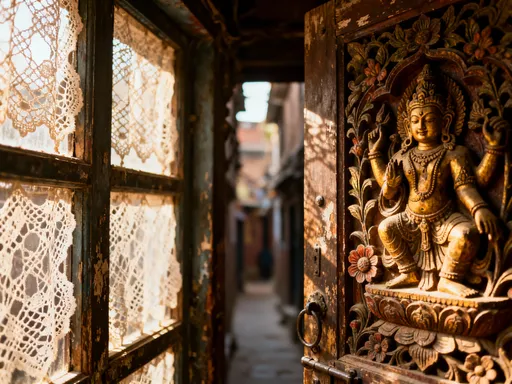
Leaving the riverfront, the city folds inward through a labyrinth of narrow alleys—some barely wide enough for two people to pass. These passageways are not mere shortcuts; they are the connective tissue of daily life. Here, homes open directly onto the street. Doors are left ajar, windows uncurtained. Cooking aromas drift out—cumin, turmeric, fresh chapati on a hot griddle—mingling with the scent of damp stone and morning dew. Life isn’t hidden behind walls; it spills into the lane, inviting participation.
A typical alley might host a flower vendor arranging marigold garlands on a low stool, a barber giving a shave under a fading awning, and a group of boys balancing a makeshift cricket bat on their shoulders. A grandmother calls down from a second-floor balcony, urging her grandson to come home for breakfast. Laundry hangs overhead like colorful flags, swaying gently in the breeze. There are no designated play areas, no private gardens—yet children find space everywhere, turning the alley into a playground, a classroom, a stage.
What’s remarkable is how these spaces function without formal design. There are no signs declaring “community zone” or “social hub.” Yet, they operate as precisely that. Neighbors know each other by name, not by address. Disputes are settled with conversation, not legal notices. A broken water pipe becomes a communal repair project; a shared roof becomes a place for evening tea and gossip. Privacy is minimal, but so is loneliness. In a world increasingly defined by digital isolation and gated communities, Varanasi’s alleys offer a counter-narrative: that closeness, not distance, fosters true belonging.
These lanes also reflect a deep-rooted resilience. Floods, heatwaves, and overcrowding are real challenges, yet the community adapts with quiet ingenuity. During monsoon season, wooden planks become temporary walkways above flooded streets. In summer, cloth canopies are strung between buildings to create shade. There’s no reliance on large-scale infrastructure—just collective wisdom, passed down through generations. The alley, in all its informality, becomes a testament to human adaptability and the enduring power of shared space.
Chai Stalls and Conversations: Public Space as Social Glue
At the heart of Varanasi’s social fabric are the humble chai stalls—tiny outposts of warmth and connection scattered throughout the city. These aren’t cafes with Wi-Fi and cushioned chairs. They’re simple setups: a kerosene stove, a dented kettle, a few plastic stools. Yet, they function as the city’s living rooms. Men, women, pilgrims, laborers, and travelers gather here not just for tea, but for conversation, for news, for a moment of rest in the middle of a long day.
I remember sitting at one such stall near Assi Ghat, steam rising from my clay cup. The vendor, a man with a weathered face and kind eyes, handed me my chai with a nod. “First time in Varanasi?” he asked. That simple question opened a floodgate of stories—about his childhood by the river, his father’s boat, the changes he’d seen over forty years. Nearby, two priests debated the timing of an evening ritual. A boatman checked his phone, waiting for tourists. A woman sold banana fritters from a tray balanced on her head. The stall wasn’t just a place to drink tea—it was a crossroads of lives.
These interactions are not incidental; they are essential. In a city where space is shared so densely, trust is built in small moments. A shared cup of tea, a borrowed umbrella, a warning about a slippery ghat—these micro-exchanges create a web of informal support. Strangers become temporary kin, united by the simple act of being present in the same space at the same time. There’s no need for social media to feel connected; the city itself is the network.
What’s most striking is the ease of these conversations. There’s no hesitation, no guardedness. People ask about your journey, your family, your beliefs—not out of curiosity alone, but out of genuine interest in your place within the human story. In Western cities, public interactions are often transactional—quick exchanges at counters, brief acknowledgments on sidewalks. In Varanasi, every encounter feels relational. The chai stall, in all its simplicity, becomes a classroom in empathy, a daily reminder that connection is not something we seek—it’s something we step into, naturally, when we allow space for it.
Dawn on the River: Silence Amidst the Crowd
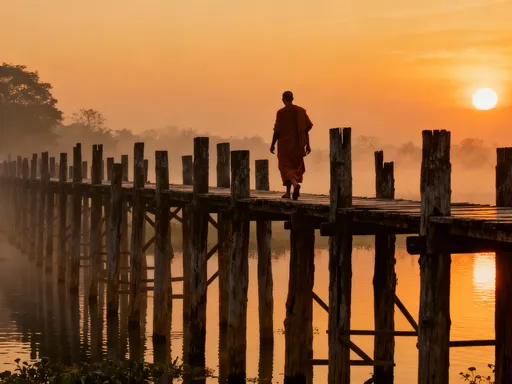
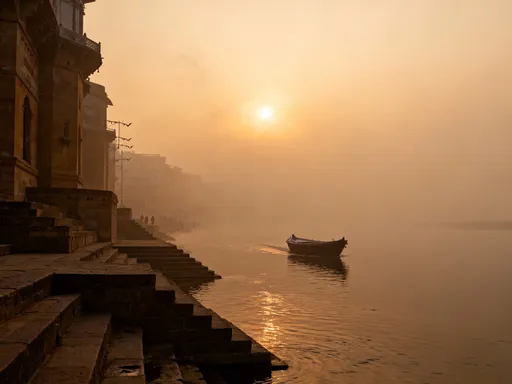
Before the city fully wakes, there is a moment of stillness. Around 5:00 a.m., when the sky is just beginning to blush with light, a boatman paddles gently away from the ghat. The water is smooth, reflecting the silhouettes of temples and palaces like ink on silk. Fog hovers just above the surface, softening edges, muffling sound. The only noises are the occasional dip of the oar, the distant call of a priest, the soft hum of a mantra carried on the breeze.
This early morning ride is one of Varanasi’s most treasured experiences—not because it’s exclusive, but because it’s shared. Dozens of small boats float along the same stretch of river, each carrying silent observers. There are no loudspeakers, no guided commentary. Just the presence of others, all gazing at the same horizon, all breathing the same cool air. It’s a rare kind of communion—one that doesn’t require words, only witness.
In this moment, the city’s usual intensity gives way to reflection. The ghats, so busy by midday, appear almost sacred in the half-light. Candles flicker in small boats, offerings drifting downstream. A woman on the bank pours milk into the river as a morning offering. A group of sadhus sit in meditation, their orange robes glowing in the dawn. The river, ancient and slow-moving, seems to hold time itself.
What makes this experience powerful is its public nature. In many cultures, silence and contemplation are reserved for private spaces—bedrooms, meditation rooms, secluded gardens. Here, they are practiced openly, collectively. There’s no shame in stillness, no rush to fill the quiet. The shared silence becomes a form of connection, deeper than conversation. It reminds us that spirituality is not always loud or performative; sometimes, it’s simply showing up, quietly, in the presence of something greater.
Public Space Under Pressure: Tourism, Crowds, and Change
Yet, Varanasi is not untouched by the pressures of modernity. The very qualities that make it magical—its density, authenticity, and openness—are also under strain. Tourism, while vital to the local economy, brings challenges. The ghats, once spaces for quiet ritual, now echo with the chatter of tour groups and the click of cameras. Waste accumulates along the riverbank, despite ongoing clean-up efforts. Plastic bottles, food wrappers, and discarded offerings wash into the Ganges, a visible reminder of the cost of mass visitation.
Overcrowding is another growing concern. During festival seasons, the narrow alleys become nearly impassable. Emergency access is limited, and sanitation systems are stretched thin. Some residents have begun to move to quieter neighborhoods on the city’s outskirts, seeking space, privacy, and modern amenities. As younger generations embrace digital lifestyles and global influences, the traditional rhythms of communal living face an uncertain future.
Efforts to balance preservation and progress are visible, though often subtle. Local initiatives promote eco-friendly rituals, encouraging biodegradable offerings and reusable containers. Certain areas have restricted motorized traffic to reduce noise and pollution. Awareness campaigns urge visitors to respect sacred spaces, to dress modestly, to refrain from photographing sensitive moments like funerals. These are not top-down mandates, but community-driven responses—slow, steady, rooted in respect rather than enforcement.
The challenge is not to modernize Varanasi into something it’s not, but to protect the essence of what makes it unique. Public space here is not a commodity to be optimized or monetized; it’s a cultural inheritance. The solution lies not in exclusion or over-regulation, but in mindful participation. Travelers can help by being present without intruding, by listening more than speaking, by leaving nothing behind but footprints of respect. The soul of Varanasi isn’t in its stones or steps—it’s in the way people live together, day after day, in shared dignity.
Why Varanasi Changes How You See Cities
Leaving Varanasi, I carried more than memories. I carried a shift in perspective—one that continues to shape how I see cities, public spaces, and human connection. In a world where urban design often prioritizes efficiency over emotion, privacy over proximity, Varanasi stands as a powerful alternative. It shows us that public space is not just about infrastructure—parks, plazas, transit hubs—but about lived experience. It’s where rituals unfold, relationships form, and life is witnessed in its full complexity.
Most modern cities are built to manage people—to move them efficiently, to house them safely, to serve them conveniently. Varanasi, in contrast, is built to hold them. It doesn’t just accommodate crowds; it embraces them. It doesn’t separate functions; it allows them to overlap, to intertwine, to coexist. In doing so, it creates a rare kind of authenticity—one that cannot be replicated in planned developments or curated experiences.
For the traveler, especially one accustomed to structured itineraries and sanitized destinations, Varanasi is a revelation. It asks not that you admire it from a distance, but that you step into its flow. It doesn’t offer comfort in the conventional sense—there’s noise, heat, unpredictability—but it offers something deeper: belonging. In its crowded alleys, its smoky ghats, its quiet dawn rides, you are reminded that you are part of something larger. Not a tourist. Not an observer. But a participant in the ongoing story of human life.
So if you go, go not to check a box or capture a perfect photo. Go to listen. Go to sit at a chai stall and let a conversation unfold. Go to walk the alleys without a map. Let the city surprise you. Let it challenge your assumptions about space, privacy, and connection. And when you leave, you may find—as I did—that you carry a piece of Varanasi not in your luggage, but in your heart. A quiet knowing that the most sacred spaces are not always the quietest, but the ones where life, in all its messy, beautiful truth, is lived out loud.